FieldNet

Predicting how membrane proteins deform the surrounding lipid bilayer, directly from structure.

Overview

Integral membrane proteins locally reshape the bilayer around them, thinning, bending, and stretching the lipids to match their hydrophobic surface. That deformation shapes how the protein works, but obtaining it is expensive. It normally takes one molecular-dynamics simulation per protein.

FieldNet learns the mapping from a protein structure to its membrane-deformation field, trained on coarse-grained simulations from the MemProtMD database. The figures below are the reference deformation fields those simulations produce. Each shows the two leaflets of a DPPC bilayer (the phosphate surfaces) reconstructed around one protein, coloured by local membrane thickness. Red marks where the membrane is thinner than its unperturbed value; blue where it is thicker.

Deformation atlas

Explore the bilayer response

A range of membrane proteins, from weak perturbers (ion channels) to strong ones (β-barrel transporters and intramembrane proteases). Select any panel to enlarge it.
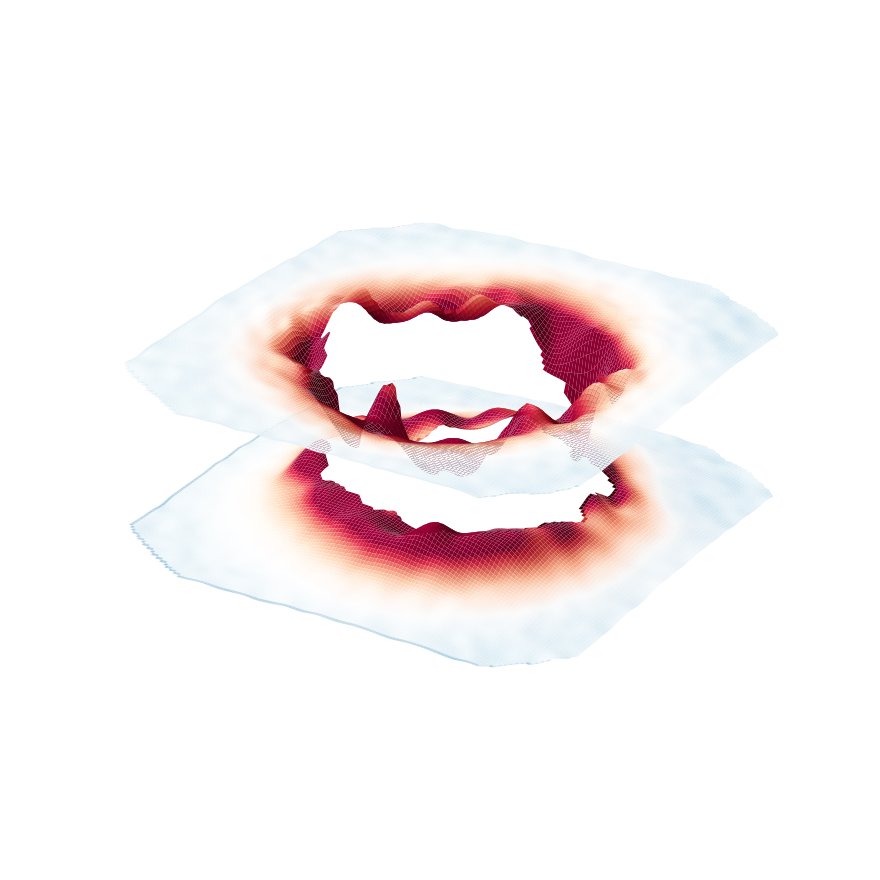
membrane deformation field
Rhomboid protease
PDB 4B7O · intramembrane serine protease
−8.5 Å
Annular thinning
2.9 Å
Deformation spread
7.4k
Grid cells
thinnerthicker

Surfaces are reconstructed from the time-averaged phosphate positions of the last 0.5 µs of each trajectory; vertical deformation is exaggerated ~1.7× for visibility. Thinning is the annular-minus-bulk membrane thickness; spread is the standard deviation of the thickness deviation around the protein, a proxy for how directional (anisotropic) the response is.

Method

How the fields are made and learned

Labels: coarse-grained molecular dynamics

We coarse-grain each protein (MARTINI 2.2), insert it into a DPPC bilayer, and simulate ~1 µs at 323 K. Averaging the trajectory gives a per-point map of the two phosphate surfaces, and we read the membrane thickness off a grid. Deviations from the unperturbed 39.9 Å reference define the deformation field FieldNet learns to reproduce.

Model: per-cell prediction with uncertainty

FieldNet takes the membrane-oriented structure and predicts, for every grid cell, the mean thickness deviation and its variance, along with a small set of angular modes that capture the direction in which the membrane thins most. Predicting a distribution instead of a point estimate lets it flag where the deformation is well-determined and where it isn't.